
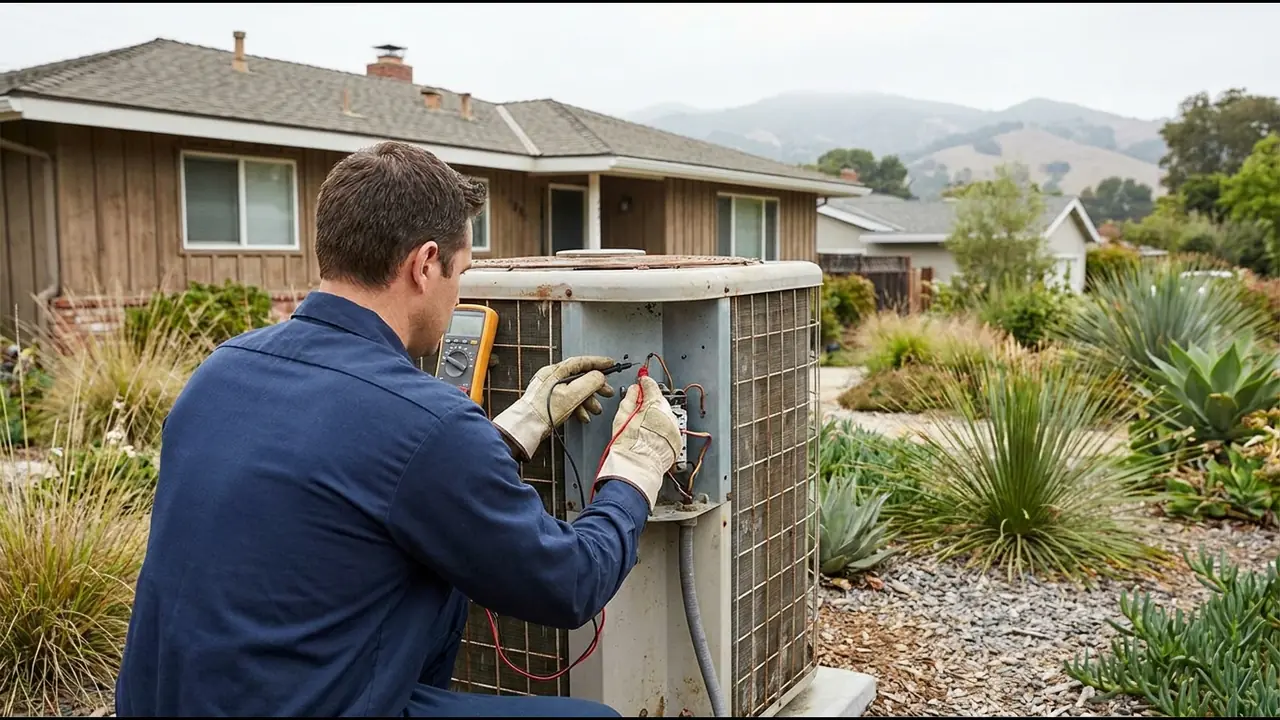
Who Repairs Air Conditioners on the San Francisco Peninsula?
Pacific Sustainable Heating & Air repairs air conditioners across the San Francisco Peninsula, troubleshooting your system to find the true root cause of your cooling issues and restore comfort to your home. Is your air conditioner running constantly but only blowing lukewarm air, making a harsh metallic grinding noise, or leaking unexplained water near the indoor unit? Those are genuine mechanical failures that require professional diagnostics, not a simple filter change or a temporary do-it-yourself fix.
How Do I Know My Air Conditioner Needs Repair?
Why Is My AC Running but Blowing Warm Air?
An AC that runs but blows warm air usually has a compromised cooling cycle, such as a severe refrigerant leak, a failed compressor that is no longer pumping, or a heavily frozen evaporator coil blocking the transfer of heat. The outdoor unit buzzes and the indoor blower pushes air through the vents, but there is no temperature drop in the house. Forcing an air conditioner to run when it cannot cool puts heavy thermal stress on the internal components, which can turn a solvable repair into a full system replacement.
What Do Strange Noises From the AC Condenser Mean?
Grinding from the AC condenser indicates that fan motor bearings are wearing out, while a loud buzz often points to a failing contactor or a blown dual-run capacitor. You may also hear a high-pitched screeching from the metal box sitting outside your house. Catching a weak capacitor early is a simple fix that can save the fan motor, whereas ignoring a screeching compressor can lead to a major mechanical failure.
Why Does My AC Shut Off After a Few Minutes?
An AC that shuts off after a few minutes and tries to restart is usually starved for airflow, losing low-voltage communication with the thermostat, or tripping a low-pressure safety switch due to a severe lack of refrigerant. That pattern is called short cycling. Short cycling wrecks your energy efficiency, fails to properly dehumidify the home, and puts repetitive wear and tear on the contactor and compressor.
Why Is My AC Leaking Water?
An AC leaking water most likely has a condensate drain line choked shut with algae and dust, or an indoor evaporator coil that has frozen solid and is now melting outside the bounds of the drain pan. You may spot water pooling around the base of the indoor air handler or a growing water stain on the ceiling beneath an attic-mounted unit. Water damage to drywall and framing is expensive to fix, and a system freezing over will eventually lock up completely.
Why Is Airflow From My AC Vents Weak?
Weak airflow from AC vents often means the indoor blower motor is failing, the evaporator coil is caked in heavy dust, or the ductwork has suffered a major structural breach. The system is running and the air feels somewhat cool, but it barely trickles out of the registers and fails to reach the far corners of the house. Running a system with restricted airflow causes the internal components to overwork, eventually leading to frozen coils or a completely burnt-out blower motor.
Why Does My AC Keep Tripping the Breaker?
An air conditioner that instantly trips the circuit breaker when it tries to start indicates a direct short to ground, a seized compressor, or a severely degraded component drawing unsafe amperage. The breaker at your main panel is a critical safety mechanism. Continually resetting a breaker that keeps tripping is dangerous and can lead to fires or serious damage to the outdoor unit.
What Causes Most AC Failures?
How Do Failing Capacitors and Contactors Affect My AC?
Failing capacitors and contactors can leave the AC compressor stalling out and, in time, failing permanently. Every time your air conditioner starts, the capacitor gives the motors the boost they need to get spinning, while the contactor acts as the heavy-duty switch allowing high voltage to pass. Over years of use, capacitors lose their ability to hold a charge, and contactors become pitted and burned from arcing. Replacing these common wear-and-tear parts can head off a compressor failure.
Why Is My AC Low on Refrigerant?
An AC that is low on refrigerant has a leak somewhere in the copper lines or the coils, because air conditioners do not consume refrigerant. Moisture can sometimes accelerate corrosion on outdoor condenser coils, while indoor copper coils can develop tiny formicary leaks over years of exposure to household chemical vapors. Depending on the size of the leak and the age of the equipment, the fix involves repairing the copper line, replacing the leaking coil, or discussing modern replacement options.
How Do Dirty Blower Wheels Cause AC Problems?
A dirty blower wheel and coil choke the air conditioner's airflow until the coil temperature drops below freezing and the coil ices over. When filter changes are skipped, household dust bypasses the filter and cakes directly onto the indoor blower wheel and the wet evaporator coil, drastically reducing the volume of air moving across the coil. Restoring proper operation requires a deep clean of the evaporator coil and pulling the blower motor assembly to scrub the wheel vanes.
Why Does My AC Trip Its Safety Switches?
An AC trips its high-pressure safety switch when a fouled condenser coil or a failing fan motor makes head pressure spike. Modern air conditioning systems are equipped with high-pressure and low-pressure safety switches designed to shut the unit down before it destroys itself, and the high-pressure switch protects the compressor from damage. Resetting a tripped breaker or safety switch over and over without diagnosing the underlying pressure issue can cause severe, irreversible mechanical damage.
What Happens When an AC Expansion Valve Fails?
An AC expansion valve that sticks open floods the compressor with liquid refrigerant, and one that sticks closed starves the coil and causes the system to freeze over. The thermostatic expansion valve controls the precise flow of liquid refrigerant into your indoor evaporator coil based on the temperature of the suction line. Diagnosing a failing expansion valve requires specialized gauges to measure superheat and subcooling, so the system can be properly balanced.
What Happens When We Troubleshoot Your AC?
AC troubleshooting uses gauge readings, amp draws, and the temperature split across the coil to show what is actually failing, rather than guessing at problems or throwing parts at a machine hoping something works. You work directly with the owner, who has more than 23 years as a union service technician.
We serve homes across the San Francisco Peninsula. You should understand what failed, why it failed, and what the repair involves so you can make an informed decision for your property. If the equipment is aging and it makes more financial sense to consider upgrading, we can walk you through your options.
Peninsula Clean Energy and BayREN offer heat pump incentives to eligible San Mateo County customers; eligibility and funding vary.
AC Repair & Service Coverage Across the San Francisco Peninsula
We provide AC repair to homeowners across these communities to help your equipment operate safely and efficiently. When your cooling system fails, we can help.
San Francisco Peninsula: San Bruno, San Francisco, San Mateo, Burlingame, Redwood City, Palo Alto
Related Services
AC replacement may be the better way to restore reliable comfort when an air conditioning repair is not the most cost-effective path forward, especially after a catastrophic compressor failure or with a system that relies on obsolete refrigerant. For homeowners looking to upgrade their efficiency or move away from gas heating, we also offer heat pump installation, providing a single, efficient system for year-round heating and cooling.
What Should I Do When My AC Stops Cooling Well?
When your AC stops cooling well and your home feels warm and humid, get a clear assessment of what is really going on inside your equipment. Ignoring the warning signs can turn a minor wiring or airflow issue into a major, expensive mechanical failure.
Call (415) 654-1160 to request an estimate and let us diagnose your cooling issues.